
Second Week
Well, the second week seems to have some students on their toes! Jim’s class had four attendees, Emma, Donard, Vicky and Alan. Alan doing well, in fact it looks as though Alan will be turfed out of Jim’s class and into Malcolm’s class.
Malcolm’s class did not take place this week because there was a contest which we all attended instead.
My class just had two, Vicky and Tony. Vicky is in an overlap situation at the moment, but judging by the amount of practice she is doing, she will be concentrating on Jim’s class. Tony, on the other hand, is finding it difficult. His age is not helping, but neither is the small amount of practice he is doing. Hopefully this will improve.
If you would like to join, you will be most welcome. There was a very good article by the US Navy on the Internet. They are teaching Morse again, having realised how useful it really is, even in modern times. In fact they suggest that every individual should learn Morse Code and to a reasonable level too. Personally I think that a great idea. In fact I would take it a step further and suggest that it should go onto the curriculum of every school in the UK, with an O level to accompany it! Please do read this article. I think you will find it interesting:
https://morsecoder.us/blog/morse-code-navy-2026
Why should I practice?
Beginners often start at low speeds where they consciously count dots and dashes (e.g., thinking 1-1-2 equals “Y”). This conscious decoding creates a speed ceiling; you cannot translate fast enough if you have to mentally map every single symbol.
Regular practice trains your brain to hear each letter or number as a unique musical rhythm or sound shape rather than a sequence of individual clicks.
On the amateur radio bands, signals deal with static, fading, and congestion. An operator who has practiced copy-flow can pull meaning through heavy noise where voice (SSB/AM/FM) or weak signals would fail completely.
Sending clean Morse code with a straight key or paddle requires rhythmic timing. Practice builds the physical consistency needed so other operators can easily read your transmission.
Software and apps help lay the foundation, but live radio environments force you to handle irregular spacing, varying speeds, and conversational abbreviations.
If you are having difficulty, it is probably because you are not devoting enough time to Practice. It should be around one hour per day. If you want extra help other than the NARC classes then consider joining the CW OPS Academy, or the Long Island Morse classes. Google searches will bring you the appropriate pages.
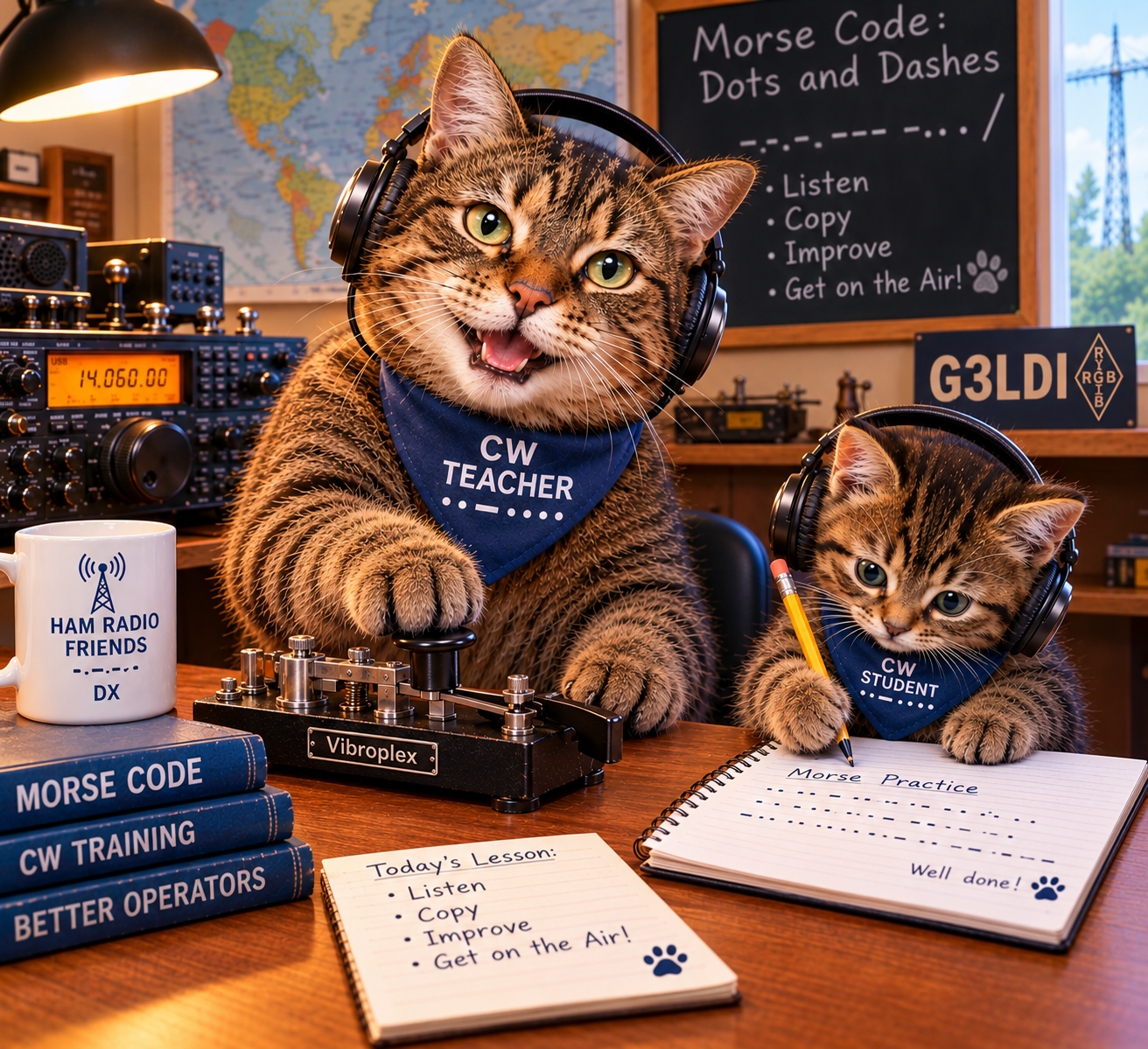
Even Cool Cat has a pupil!

NARC Net
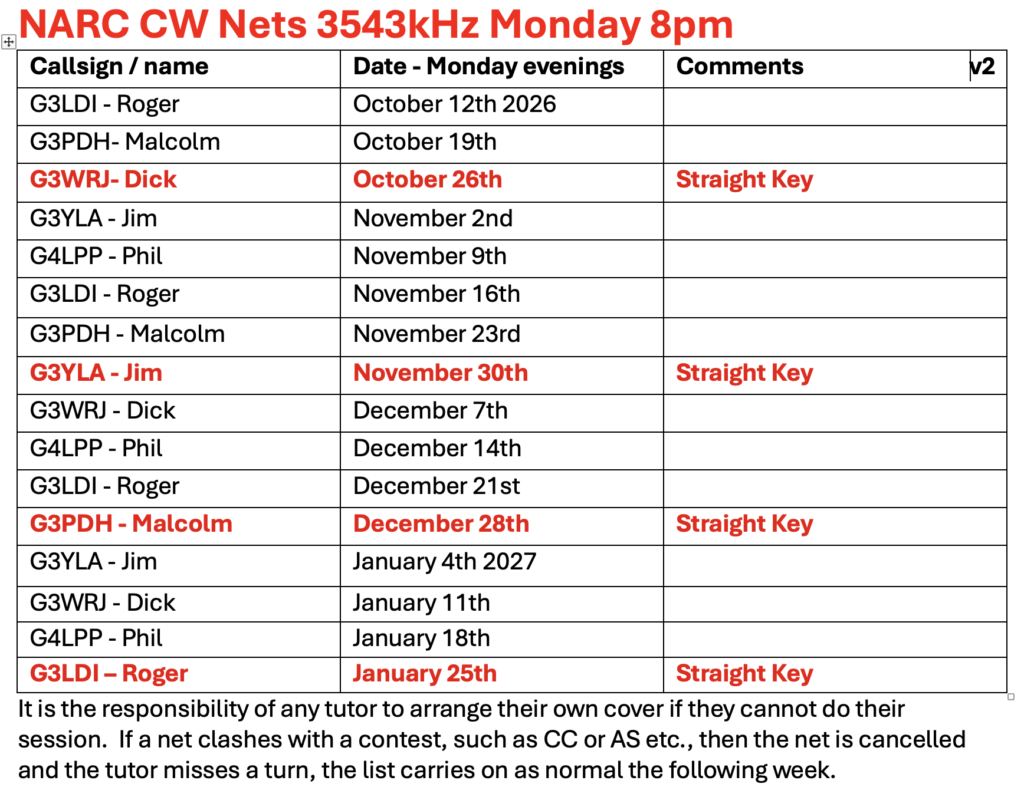
This takes place every Monday evening at 8 p.m. clock time on 3543kHz. Feel free to join in a short Net for practice with conversational Morse. We will conduct it at your speed, but if nobody joins we simply have a chat at 25wpm.
“Do today what others won’t, so you can do tomorrow what others can’t.”
This week we had G3PDH, G3LDI, M9BLX, G3YLA and G3WRJ. It’s good fun and great practice.
Hope to see you one Monday evening. Try it, you might like it!

73 May the Morse be with you Roger G3LDI